Are You Solving Today’s Remote Work Challenges with Yesterday’s Solutions?
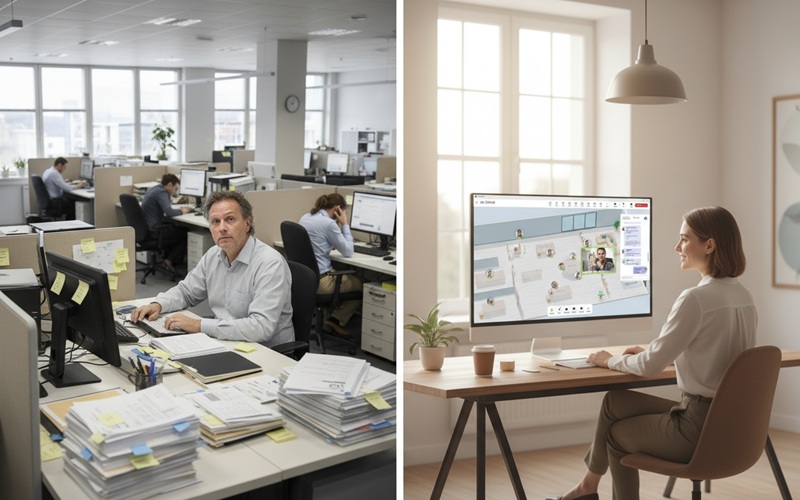
Remote and hybrid work have transformed how teams operate — and what employees value.
For many, the ability to work from home offers better work–life balance, flexibility, and less time lost commuting. Employers, in turn, benefit from access to a wider talent pool and reduced need for office space.
But the transition hasn’t been without friction. When colleagues aren’t in the same location, communication gaps can appear. Some employees feel disconnected, missing the casual social contact that builds trust and cohesion. Managers, too, can find it harder to stay in touch, leading to uncertainty around priorities and expectations.
At the same time, others struggle to switch off at the end of the day — blurring the boundaries between work and home. The result is often increased stress, disengagement, and burnout.
The Trap of Pre-Pandemic Solutions
When facing these issues, many organisations fall back on familiar management tools — ones designed for a time when everyone worked in the same place.
Some take the drastic route: ordering employees back to the office. It’s an approach that can backfire quickly. A recent McKinsey survey found that 17% of resignations were caused by return-to-office mandates — second only to pay-related reasons. Morale drops, turnover rises, and recruitment become harder.
Other organisations introduce stricter hybrid rules: fixed office days, rigid schedules, more check-ins, or increased reporting. While these measures may offer managers a sense of control, they often lead to unintended consequences — too many meetings, disrupted focus, and creeping micromanagement. Employees feel watched rather than trusted, and productivity suffers.
These are yesterday’s solutions. The work environment has changed, but the management habits often haven’t.
Online Office the New Approach
The key isn’t to discard what works — it’s to adapt it. Leadership principles that succeed in person, like visibility, connection, and trust, remain vital in hybrid settings. What needs to change is how they’re delivered.
A Online Office bridges that gap. Instead of piecing together separate apps for meetings, chat, and project management, a online office creates a single, shared digital space — a sense of working together even when physically apart.
Take BeZoned, a online office solution designed for Microsoft Teams and hybrid environments. It reintroduces everyday presence and connection into digital work life.
With BeZoned, teams can:
Instantly see who’s online and what they’re working on.
Check colleagues’ availability — whether they’re in a meeting, collaborating, or taking a break in the online lounge.
Start spontaneous conversations, just as you would at the office desk.
Move into breakout rooms or use a shared whiteboard for brainstorming sessions.
This everyday visibility builds alignment, trust, and accountability — not through control, but through shared awareness. When teams can see one another, collaboration becomes natural and fast. Ideas flow more freely, decisions happen sooner, and problems are solved earlier.
Yesterday’s Solutions vs. Today’s Online Office
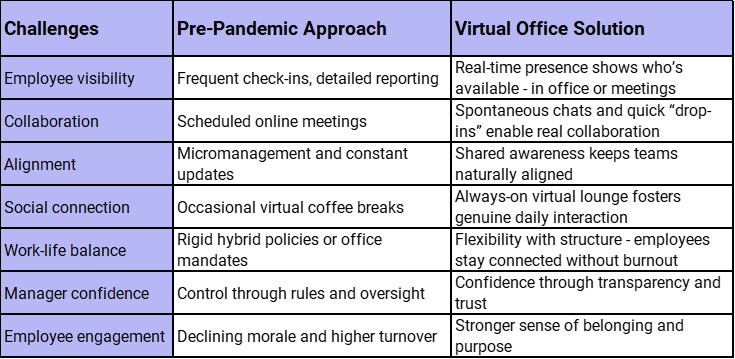
From Control to Connection
What makes online offices so powerful is that they restore human connection — not through more meetings or stricter policies, but by making digital workspaces feel alive again.
People managers can focus on what they do best: leading, not monitoring. Employees gain clarity and community without losing autonomy.
Ultimately, the future of work isn’t about returning to old systems or doubling down on control. It’s about building workplaces — online or otherwise — where visibility, trust, and collaboration thrive naturally.
And that’s what solutions like BeZoned make possible.
Author: Peter Soerensen